
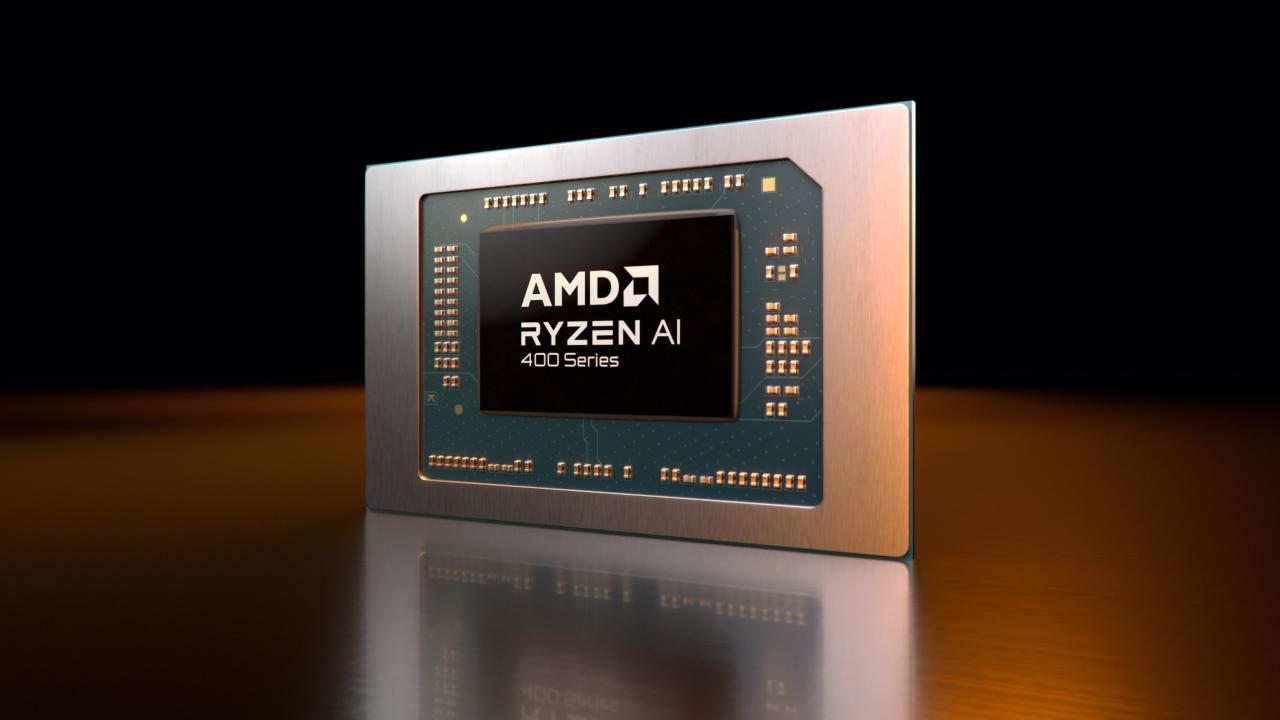
The landscape of personal computing is undergoing a seismic shift. For years, the battle for processor supremacy was fought primarily on the grounds of raw clock speeds, core counts, and thermal design power. While these factors remain crucial, a new, more disruptive force has entered the arena: Artificial Intelligence. The ability for a laptop to process complex AI models locally, without relying on cloud servers, is no longer a futuristic concept; it is the current frontier of technology, and AMD is making a powerful statement with its latest Ryzen AI 400 series of laptop chips.
At CES 2026, AMD officially unveiled the Ryzen AI 400 series, a lineup that builds upon the solid foundation of its highly successful Ryzen AI 300 “Strix Point” predecessors . Codenamed “Gorgon Point,” this new generation of processors represents a significant step forward in AMD’s mission to integrate AI at every level of computing. The primary focus is clear: to deliver exceptional performance for traditional computing tasks while simultaneously unlocking the potential for next-generation, AI-powered workflows directly on the device.
These processors are designed to be the new standard for modern laptops, from sleek ultraportables to powerful gaming machines and mobile workstations. They combine the latest CPU, GPU, and NPU technologies to provide a seamless, intelligent, and efficient user experience. The core message from AMD with the Ryzen AI 400 series is a commitment to pushing the boundaries of what is possible in a laptop, ensuring that users are not just keeping up with the pace of technology, but are at the forefront of it.
This article will provide an in-depth analysis of the AMD Ryzen AI 400 series. We will explore its technical specifications, the significance of its AI capabilities, its performance benchmarks against competitors, and what it means for the future of laptops and desktop PCs. Whether you are a professional, a creator, a gamer, or a tech enthusiast, this comprehensive guide will detail why these new processors are poised to define the next era of computing.
Understanding the “Gorgon Point” Architecture
To appreciate the capabilities of the Ryzen AI 400 series, it is essential to understand the architectural design that powers it. The series is an evolution of the previous generation, refining and enhancing the core technologies that have made AMD a formidable force in the processor market.
The “Gorgon Point” chips are built on a hybrid architecture that combines two types of cores: “Zen 5” performance cores and “Zen 5c” efficiency cores. This approach allows the processor to intelligently allocate tasks, using the powerful Zen 5 cores for demanding workloads like gaming and content creation, while the more power-efficient Zen 5c cores handle background tasks and lighter applications to save battery life. This is the same fundamental architecture that powered the Ryzen AI 300 series, but with crucial refinements that elevate the experience .
The technology is rooted in a high-performance manufacturing process. The chips are fabricated on the advanced TSMC N4P FinFET node . This cutting-edge manufacturing technology is key to achieving higher clock speeds and improved power efficiency compared to previous generations. It allows AMD to pack more transistors into a smaller space, enabling the increased performance and features of the Ryzen AI 400 series without a significant increase in power consumption. The combination of a refined architecture and a top-tier manufacturing process ensures that these processors deliver a perfect balance of power and efficiency, making them ideal for the demanding world of modern mobile computing.
The Core Specifications and SKU Breakdown
The Ryzen AI 400 series is a versatile lineup designed to cater to a wide range of users and budgets. It comprises seven distinct models, ranging from the entry-level Ryzen AI 5 430 to the flagship Ryzen AI 9 HX 475. This structured approach allows laptop manufacturers to build devices that meet specific performance and price points, ensuring that there is a “Gorgon Point” chip for nearly every type of user.
The table below provides a detailed breakdown of the specifications for each model in the lineup :
| Model | Cores / Threads | Max Boost Clock | Cache (L2+L3) | NPU TOPS | Graphics (RDNA 3.5) | Memory Support | TDP Range |
|---|---|---|---|---|---|---|---|
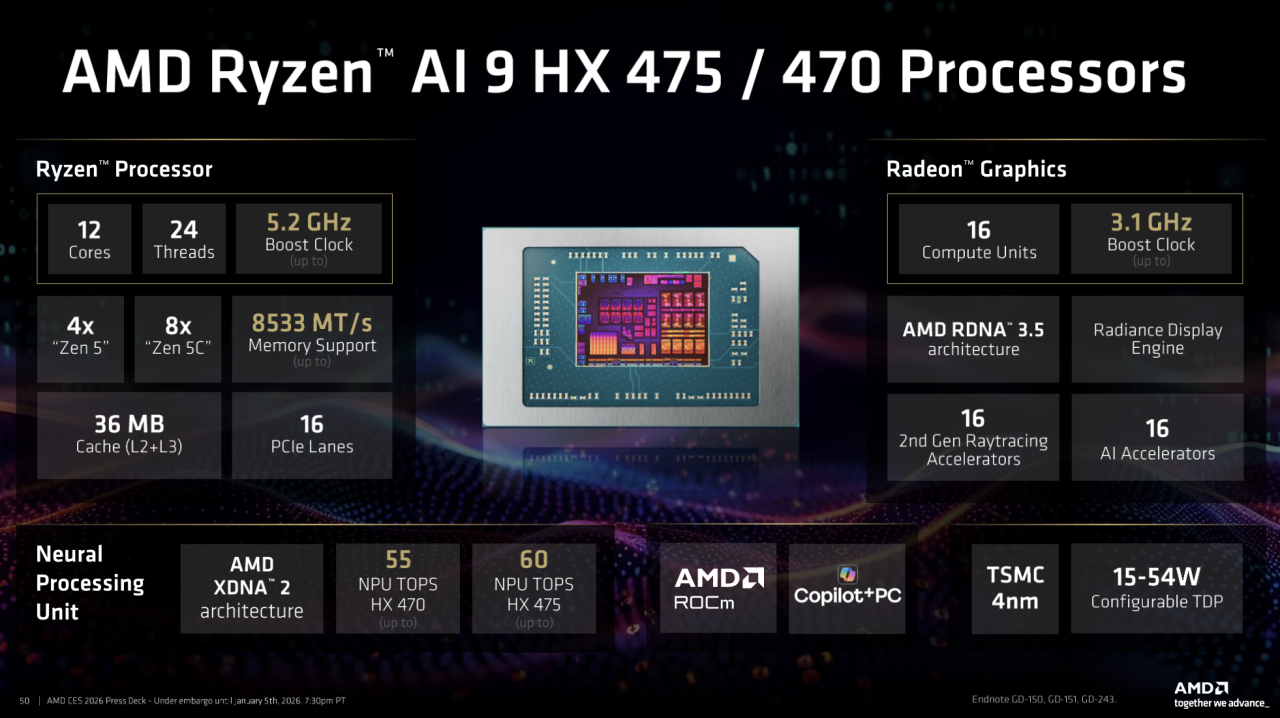
| Ryzen AI 9 HX 475 | 12 / 24 | 5.2 GHz | 36 MB | 60 | 890M / 16 CUs @ 3.1 GHz | 8533 MT/s | 15-54W |
| Ryzen AI 9 HX 470 | 12 / 24 | 5.2 GHz | 36 MB | 55 | 890M / 16 CUs @ 3.1 GHz | 8533 MT/s | 15-54W |
| Ryzen AI 9 465 | 10 / 20 | 5.0 GHz | 34 MB | 50 | 880M / 12 CUs @ 2.9 GHz | 8533 MT/s | 15-54W |
| Ryzen AI 7 450 | 8 / 16 | 5.1 GHz | 24 MB | 50 | 860M / 8 CUs @ 3.1 GHz | 8533 MT/s | 15-54W |
| Ryzen AI 7 445 | 6 / 12 | 4.6 GHz | 14 MB | 50 | 840M / 4 CUs @ 2.9 GHz | 8000 MT/s | 15-54W |
| Ryzen AI 5 435 | 6 / 12 | 4.5 GHz | 14 MB | 50 | 840M / 4 CUs @ 2.8 GHz | 8000 MT/s | 15-54W |
| Ryzen AI 5 430 | 4 / 8 | 4.5 GHz | 12 MB | 50 | 840M / 4 CUs @ 2.8 GHz | 8000 MT/s | 15-54W |
A close look at the table reveals the key differences between the models. The flagship Ryzen AI 9 HX 475 and HX 470 are the only chips with the top-tier NPU performance of 60 and 55 TOPS, respectively. They also share the most powerful integrated GPU, the Radeon 890M with 16 Compute Units. The Ryzen AI 9 HX 475 is the only chip in the lineup to reach the full 60 TOPS of AI performance, a testament to its position as the absolute top of the line. All other models feature NPUs that deliver a still-impressive 50 TOPS .
The Heart of AI: The XDNA 2 NPU
The most defining feature of the Ryzen AI 400 series is its powerful Neural Processing Unit (NPU). Built on AMD’s advanced XDNA 2 architecture, this dedicated silicon is engineered to accelerate AI workloads with exceptional efficiency. While the CPU and GPU can handle AI tasks, the NPU is specifically designed for this purpose, allowing it to process complex neural networks with far greater energy efficiency than general-purpose cores. This is crucial for laptops, where preserving battery life is a primary concern.
The NPU performance is measured in TOPS (Trillion Operations Per Second). The top-tier model, the Ryzen AI 9 HX 475, delivers up to 60 TOPS of raw AI processing power. This represents a roughly 20% increase over the 50 TOPS achieved by the flagship NPUs in the previous generation . This is a significant leap, as it provides developers with more headroom to create innovative AI applications without worrying about performance bottlenecks. For the end user, this translates to faster and more responsive AI features. For instance, tasks like real-time language translation, background noise removal in video calls, or AI-driven photo enhancements will be processed more quickly and efficiently, often without the user even noticing the computational load .
A key milestone this NPU achieves is the comfortable surpassing of Microsoft’s 40 TOPS requirement for the coveted “Copilot+ PC” certification . This ensures that laptops powered by these chips can fully leverage all the AI features built into Windows 11, including Copilot, Windows Studio Effects, and the controversial but potentially transformative Recall feature . The inclusion of a high-performance NPU means that these advanced AI features are not just a novelty but a fundamental, integrated part of the user experience. This dedication to on-device AI processing, championed by AMD, is a cornerstone of the company’s strategy to make intelligent computing a standard feature for all users.
Integrated Graphics Performance
While the AI capabilities are the headline feature, the Ryzen AI 400 series also delivers a significant boost in graphical performance, thanks to the integration of AMD’s RDNA 3.5 graphics architecture . This is a refinement of the RDNA 3 technology, offering improved performance-per-watt, making it ideal for thin and light laptops where dedicated graphics cards are not an option.
The flagship Ryzen AI 9 HX 475 comes equipped with the powerful Radeon 890M iGPU, which features 16 Compute Units (CUs) and can boost up to 3.1 GHz . This is a noticeable improvement over the previous generation’s top clock speeds, enabling smooth gameplay in popular titles and accelerating content creation workflows like video editing and 3D rendering. According to AMD, laptops powered by the Ryzen AI 9 HX 470 can achieve a 1.1x boost in gaming performance compared to the competition, with specific titles showing even more significant gains, such as a 53% increase in Forza Horizon 5 and a 36% increase in Cyberpunk 2077 .
The improved memory controller, which now supports LPDDR5X memory speeds of up to 8533 MT/s, is another key contributor to enhanced graphics performance . This faster memory provides the iGPU with the bandwidth it needs to handle complex visual data, resulting in higher frame rates and smoother visuals. The combination of the RDNA 3.5 architecture and the high-speed memory ensures that the Ryzen AI 400 series can deliver a premium visual experience, making it a compelling choice for gamers, streamers, and creative professionals who demand the best integrated graphics.
Power Efficiency and the Promise of Multi-Day Battery Life
One of the most compelling aspects of the Ryzen AI 400 series is its focus on power efficiency. By combining high-performance cores, an efficient NPU, and optimized architecture on the advanced 4nm process, AMD has engineered these chips to provide an exceptional balance of power and battery life. The company has leveraged its platform-level optimizations, ensuring that the processor is not only powerful but also intelligent about when and how to use that power.
AMD has released some impressive battery life claims for laptops powered by these chips. The company states that laptops featuring the Ryzen AI 7 445 processor can achieve up to 24 hours of video playback and up to 20 hours of web browsing . This kind of endurance suggests that the phrase “all-day battery life” is no longer an aspiration but a reality. It enables true mobility, allowing professionals and students to work unplugged for extended periods without constantly searching for an outlet.
Furthermore, the NPU plays a critical role in extending battery life by offloading AI tasks from the main CPU and GPU. Because the NPU is highly specialized, it can perform these tasks using significantly less power. This allows the processor to stay in a lower-power state for longer, directly translating into substantial battery savings during AI-heavy workflows. This is the “multi-day mobility” that AMD is promising with the Ryzen AI 400 series—a future where users can rely on their laptops for days of light usage on a single charge . The combination of high performance and exceptional efficiency makes these chips ideal for the modern, mobile lifestyle.
Performance Comparisons and Competitive Landscape
The “Gorgon Point” chips enter a highly competitive market, going head-to-head against next-generation processors from Intel and Qualcomm. To establish its position, AMD has provided performance metrics positioning the Ryzen AI 400 series against competitors like Intel’s Lunar Lake architecture. The company claims significant advantages in various key areas. In multitasking, AMD claims a 1.2x to 1.3x improvement, and more impressively, a 1.7x boost in content creation performance . This suggests that the hybrid Zen 5 architecture provides a tangible performance edge in professional applications, a critical factor for creative professionals and power users.
Where the Ryzen AI 400 series truly shines, according to AMD’s data, is in unplugged productivity. The company claims a 1.7x advantage in performance when running on battery power, indicating that “Gorgon Point” laptops do not significantly throttle performance when unplugged, providing a consistent and responsive experience anywhere . In AI-specific tasks, the NPU’s performance is a clear differentiator, as it surpasses the NPUs found in competitors’ current offerings .
In gaming, the integrated RDNA 3.5 graphics deliver performance that competes strongly with dedicated entry-level GPUs, making these chips a great option for portable gaming. Titles like Black Myth: Wukong and Monster Hunter Wilds have been shown to achieve double-digit performance gains against the competition . However, some industry analysis suggests that the Ryzen AI 400 series is a minor iterative update, and the forthcoming Intel Panther Lake and Qualcomm Snapdragon X2 could pose a more significant challenge later in the year . Nevertheless, for the first half of 2026, the Ryzen AI 400 series establishes a formidable presence in the market.
The Use Cases: Who is the Ryzen AI 400 For?
With a diverse lineup and a focus on AI, the Ryzen AI 400 series is designed to cater to a broad spectrum of users, each with specific needs. The chip’s versatility ensures that there is a model suited for a wide range of applications .
A. Knowledge Workers and Power Users
For professionals who spend their days multitasking across office applications, video conferencing, and complex spreadsheets, the Ryzen AI 400 series provides a responsive and efficient experience. The powerful CPU ensures smooth multitasking, while the NPU accelerates features like real-time transcription, intelligent summarization, and background noise cancellation for crystal-clear video calls. The advertised battery life is particularly beneficial for those who are constantly on the move.
B. Content Creators and Developers
This is where the AI capabilities of the Ryzen AI 400 series truly come into their own. For photo editors, video editors, and designers, the NPU can dramatically speed up workflows . Tasks like AI-assisted photo editing in Adobe Photoshop and Lightroom, video encoding in DaVinci Resolve, and 3D rendering in Blender can be offloaded to the NPU or the powerful integrated GPU, resulting in faster rendering times and a smoother creative process . Developers experimenting with local AI models and automation will also find the high TOPS performance invaluable for rapid prototyping and testing.
C. Gamers and Enthusiasts
The “Gorgon Point” chips are a boon for gamers seeking a thin and light laptop. The RDNA 3.5 graphics, combined with high-speed memory, deliver impressive 1080p gaming performance for a wide range of titles. The 1.1x gaming performance boost claimed by AMD means that users can enjoy their favorite games at respectable settings without sacrificing portability. The high refresh rates and smooth visuals make them suitable for both casual and competitive gaming sessions.
D. The Everyday User
Even for users who don’t identify as “power users” or “creators,” the benefits of the Ryzen AI 400 series are tangible. AI features are becoming increasingly integrated into the fabric of the Windows experience. Features like Windows Studio Effects for video calls, Cocreator for digital art, and Live Captions for accessibility all rely on the NPU . The Ryzen AI 400 series ensures that these everyday AI experiences are fast, responsive, and power-efficient, making the laptop smarter and more intuitive for everyone.
Compatibility and Platform Features
The Ryzen AI 400 series is designed to be a comprehensive platform, not just a powerful CPU. It comes with a rich set of features that enhance overall system connectivity and performance. One of the key improvements is the support for faster LPDDR5X memory, with the higher-end models supporting speeds up to 8533 MT/s . This high-speed memory is crucial for feeding data to both the CPU cores and the powerful integrated GPU, ensuring that the system can handle the most demanding tasks without bottlenecking.
Connectivity is another strong point of the platform. The processors natively support up to 16 PCIe 4.0 lanes, allowing for fast SSDs and other peripherals . They also include support for multiple high-speed USB ports, including two native USB 40Gbps (USB4) ports and two native USB 10Gbps ports . This ensures that users can connect the latest high-speed storage devices, docking stations, and external monitors with ease.
Furthermore, the Ryzen AI 400 series is fully compliant with the Copilot+ PC standard . This means that laptops powered by these chips will be equipped to run the full suite of next-generation AI features in Windows 11 from day one. The platform also features support for AMD’s ROCm software stack, an open-source platform that gives developers a powerful toolkit for creating and running AI applications on AMD hardware . This focus on an open ecosystem is a key differentiator for AMD, fostering innovation and ensuring broad software support.
Market Launch and Availability
AMD has announced that the Ryzen AI 400 series will be available in laptops and mini-PCs starting in the first quarter of 2026 . This means that consumers can expect to see new devices powered by these chips hitting the market very soon. The rapid release following their announcement at CES 2026 indicates that AMD and its partners are ready to bring this new technology to users quickly.
A wide range of major OEMs (Original Equipment Manufacturers) are on board to release laptops featuring the new processors. This includes industry giants such as Acer, Asus, Dell, HP, Lenovo, MSI, and Gigabyte, among others . The involvement of these key players demonstrates a strong industry-wide endorsement of the AMD platform and ensures that users will have a wide variety of laptops to choose from, spanning different designs, form factors, and price points.
In addition to the standard Ryzen AI 400 series, AMD has also announced a Ryzen AI PRO 400 series for enterprise users . These chips are expected to be released later in the first quarter and are designed to offer the same performance and AI capabilities with additional security, manageability, and reliability features that are crucial for business IT environments. This parallel launch underscores AMD’s commitment to bringing its AI vision to every market segment.
Conclusion: Ushering in the Intelligent Era
The AMD Ryzen AI 400 “Gorgon Point” series represents a major milestone in the evolution of laptop processors. While it may be characterized as a refinement and optimization of the previous generation, it is a refinement of a very successful formula. By enhancing the NPU performance, boosting CPU and GPU clocks, and supporting faster memory, AMD has created a lineup of chips that are not just faster, but demonstrably smarter.
These processors are built to meet the demands of the new AI-centric computing era. The powerful XDNA 2 NPU, capable of up to 60 TOPS, is the key that unlocks a host of new and compelling on-device AI experiences. From accelerating creative workflows in professional applications to improving everyday tasks like video conferencing and web browsing, the Ryzen AI 400 series puts powerful intelligence directly into the hands of users.
The promise of multi-day battery life, combined with exceptional CPU and integrated graphics performance, makes these chips ideal for a wide array of laptops, from the thinnest ultraportables to the most powerful gaming rigs. With strong support from major OEMs and a clear commitment to AI leadership, AMD is poised to solidify its position as a dominant force in the mobile processor market. The “Gorgon Point” chip is a powerful statement that the future of laptop computing is not just about what a processor can do, but how intelligently it can do it, and AMD is leading the charge.