

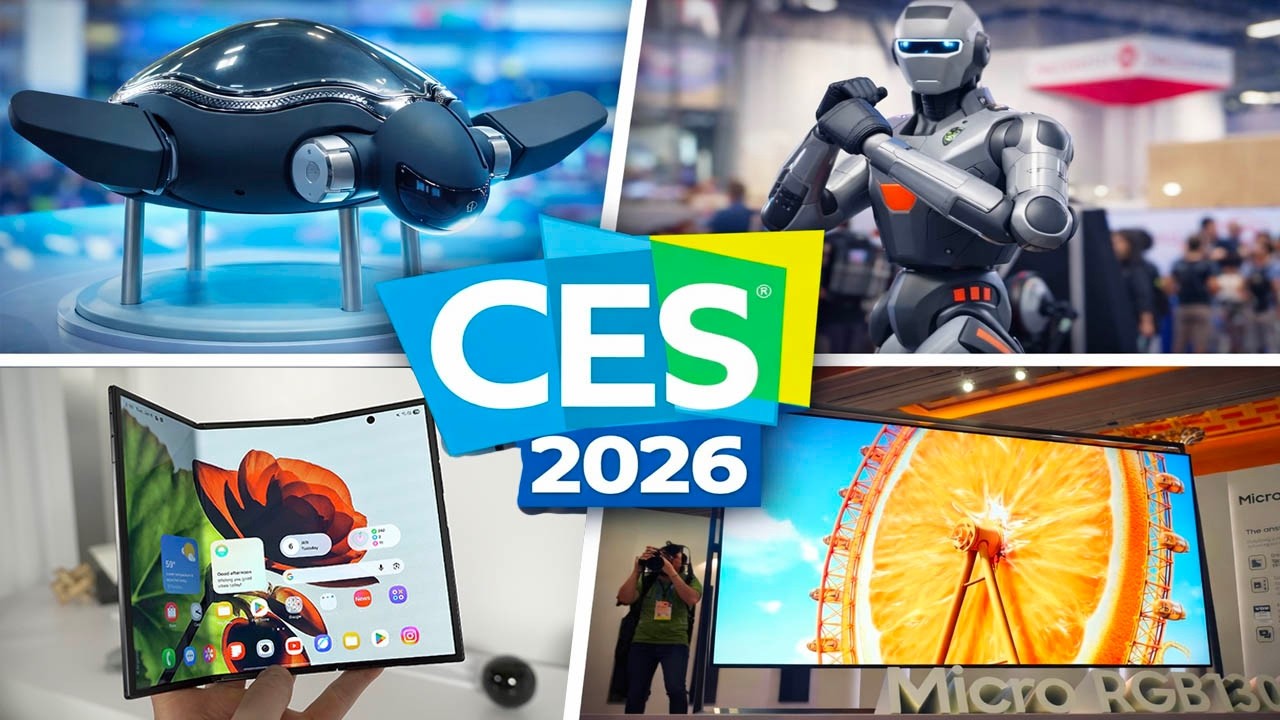
The annual Consumer Electronics Show (CES) in Las Vegas has once again proven why it remains the world’s most anticipated technology exhibition. While CES 2026 showcased groundbreaking advancements in artificial intelligence, sustainable energy, and next-generation computing, the event’s true charm often lies in its weirdest, most unexpected inventions. This year, over 4,500 exhibitors, including 1,400 startups, descended upon Las Vegas to demonstrate innovations ranging from the genuinely practical to the gloriously absurd . From lollipops that play music through your skull to laundry-folding robots, CES 2026 delivered a spectacular array of gadgets that made attendees stop, stare, and ask, “Wait, this is real?”
The Surreal World of Sensory Technology
A. The Bone-Conduction Musical Lollipop
Among the most talked-about oddities at CES 2026 was the Lollipop Star, a creation that redefines the concept of “music to my ears.” Developed by Lava Tech Brands, this single-use candy employs bone conduction technology to transmit sound vibrations through the teeth and jawbone directly to the inner ear . When users lick or bite the lollipop, piezoelectric components vibrate at ultrasonic frequencies, delivering audio that only the person eating the candy can hear . The sensation was described by attendees as a tingling feeling followed by music emerging inside their heads rather than through their ears .
The Lollipop Star launched in three distinct flavors, each paired with exclusive tracks from popular artists: Ice Spice’s “Munch” for peach, Akon’s “Beautiful Day” for blueberry, and Armani White’s “Mount Pleasant” for lime . Priced at approximately $8.99, these disposable treats offer a novel way to experience bone conduction technology, even if the audio quality doesn’t match traditional headphones . As Cassie Lawrence, spokesperson for Lollipop Star, explained, “When you eat the candy, you start listening to music and enjoying the sound as you nibble” . The product exemplifies how CES often serves as a playground for sensory experimentation.
B. Color-Changing Nails with iPolish
Fashion technology took a bold leap forward with iPolish, a system that allows users to change their nail colors on demand. The concept employs electrophoretic film applied to acrylic nails, which can be transformed using a small device that emits an electric field . Through a companion app, users can select from over 400 colors and shift each nail’s shade almost instantly . The starter kit is priced at $95 and has already opened for pre-orders, making this futuristic beauty tech surprisingly accessible . It represents a fascinating intersection of wearable technology and personal expression.
C. The LED Skylight Ceiling
Govee introduced its smart ceiling lights designed to mimic real skylights. The system features LEDs that simulate sky-light color and clarity using advanced edge-lighting technology . More impressively, the Ceiling Light Ultra incorporates AI-generated content and pixel-level editing through a 616 Ultra-Dense Pixel Matrix, allowing homeowners to transform their ceilings into dynamic displays of clouds, stars, or custom patterns . While the concept of an artificial skylight isn’t new, Govee’s integration of AI and pixel-level control pushes the boundaries of ambient lighting.
The Rise of Domestic Robots and AI Assistants
A. LG CLOiD: The Humanoid Home Helper
LG’s CLOiD robot emerged as one of the most ambitious domestic robots showcased at CES 2026. This humanoid assistant features fully articulated shoulders, elbows, wrists, and five independent fingers, mounted on self-propelled wheeled bases . The robot’s head serves as a central AI hub integrated with LG’s ThinQ ecosystem, enabling it to communicate via voice and display vivid facial expressions . CLOiD can perform household tasks including folding clothes, loading dishes into the dishwasher, and even serving food .
However, the robot still faces physical limitations; its arms can only manipulate objects at knee height or higher, meaning it cannot yet pick up items from the floor . Despite operating at a leisurely pace that some observers described as “snail-like,” CLOiD represents LG’s vision for a future where robotic assistants manage household chores, freeing humans from mundane tasks . The company calls it a “glimpse into the future” and promises a “labor-free home” .
B. Jennie the Robotic Labrador
Tombot introduced Jennie, a lifelike robotic Labrador designed specifically to provide emotional support for individuals unable to care for real pets . Inspired by CEO Tom Stevens’ mother, who has Alzheimer’s and could no longer own a real dog, Jennie features sensors that respond to touch and can execute voice commands . The robot uses recordings from a 12-week-old Labrador puppy to produce authentic-sounding dog noises and can be charged overnight for all-day operation . This robotic companion aims to address the growing need for emotional support among elderly populations and those with disabilities.
C. Sweekar: The Pocket-Sized AI Pet
For those seeking companionship in an even more compact form, Sweekar offers a pocketable AI pet that “grows up with you.” The device starts as an egg that hatches after two days, allowing users to talk to it, feed it, and change its outfits . Through a companion app, Sweekar learns about its user’s preferences and habits, creating a personalized experience . Scheduled for a Kickstarter campaign in March, Sweekar is expected to retail between $100 and $150 . It represents a fascinating trend toward digital pets that evolve alongside their owners.
D. An’An: The Panda Companion for Seniors
Mind with Heart Robotics unveiled An’An, an AI-powered panda designed specifically for elderly care. Packed with numerous sensors throughout its body, An’An reacts naturally when users interact with it . The AI remembers the user’s voice, interaction patterns, and preferences, delivering increasingly personalized experiences over time . Beyond companionship, An’An can remind users about tasks and offer medical support, making it both an emotional and practical companion for seniors .
Smart Home Innovations That Defy Expectations
A. The Ultrasonic Chef’s Knife
Seattle Ultrasonics introduced the C-200, the world’s first kitchen knife incorporating ultrasonic vibration technology . The blade vibrates up to 40,000 times per second using piezoelectric ceramic crystals, dramatically reducing friction and cutting effort by up to 50% . Users can slice paper-thin ingredients without requiring pressure, and the vibrations prevent food from sticking to the blade . Made from Japanese AUS-10 steel, the 8-inch knife functions smoothly even when unpowered .
For individuals with arthritis or limited hand strength, the C-200 offers a practical solution to everyday cooking challenges. The knife incorporates smart sensors that automatically detect food firmness and adjust vibration frequency accordingly . Operating on a rechargeable battery via wireless charging base, the C-200 also features safety mechanisms that only activate the ultrasonic system when properly held . Priced at $399 with an additional $149 for the wireless charging station, this innovative kitchen tool pushes the boundaries of what a knife can be .
B. Samsung’s Voice-Activated Refrigerator
Samsung’s Bespoke AI Refrigerator Family Hub demonstrated how even the most mundane household appliances can be transformed with technology. The refrigerator features voice-activated doors that open over 90 degrees upon voice command, though physical handles remain for traditionalists . More significantly, Google Gemini powers the upgraded AI Vision, enabling the fridge to identify 37 types of fresh food and 50 pre-registered items . The system alerts users when food approaches spoilage and suggests ordering groceries, effectively turning the refrigerator into a smart food management system .
C. AI-Powered Ice Maker
GoveeLife unveiled a smart ice maker utilizing AI NoiseGuard technology to minimize operational noise. The system uses artificial intelligence to predict when freezing will occur and defrosts accordingly to reduce sound . Dubbed the Smart Nugget Ice Maker Pro, it can produce ice in just six minutes and retails for $499.99 . While an ice maker might not seem revolutionary, the application of AI to reduce noise demonstrates how artificial intelligence is permeating even the most unexpected household appliances.
D. The Toilet That Analyzes Your Health
The Throne toilet-mounted computer uses cameras and microphones to analyze bowel movements, establishing personal baselines for bathroom habits . Designed to flag changes that might indicate digestive or metabolic issues, the system particularly benefits people taking GLP-1 drugs . Similarly, Vivoo introduced a clip-on smart toilet that analyzes urine and a menstrual pad that tracks fertility and hormone markers . These products reflect CES 2026’s commitment to quantifying every aspect of health, even the most private bodily functions.
Personal Care and Beauty Tech

A. AI Hair Clippers
Startup Glyde introduced the world’s first smart hair clipper, featuring a system that helps users achieve professional-quality haircuts at home . The clipper uses built-in sensors to monitor the user’s hand speed, angle, and tilt, automatically adjusting blade positioning to prevent uneven fades and overcuts . Users select their desired hairstyle through a companion app, and the machine adjusts cutting parameters accordingly . A notably dorky-looking face band must be worn during use, enabling the clippers to track position on the head . While the concept of AI-assisted haircutting might raise eyebrows, Glyde claims the system is “mistake-proof” .
B. Dreame Halo: The Hairdryer Floor Lamp
Perhaps one of the most bizarre product concepts at CES 2026 was Dreame’s Halo, a C-shaped floor lamp that doubles as a hairdryer . Standing as tall as a floor lamp, this contraption not only dries hair but also incorporates red light therapy to revitalize the scalp and a protective mist for hair care . When not in use, it serves as a floor lamp and mood light . Priced at $700, Dreame promises whisper-quiet operation at 59 dB and a wheeled base for easy mobility . Critics questioned whether the device could effectively dry hair, especially since its demonstration unit wasn’t operational at the show .
C. L’Oréal LED Eye Mask
L’Oréal’s beauty tech lineup included a semi-transparent silicone LED eye mask featuring visible microcircuitry for a sci-fi aesthetic . The mask precisely controls red and near-infrared wavelengths during 10-minute sessions designed to rejuvenate the delicate skin around the eyes . The company is developing a companion serum to complement the treatment, ensuring skin doesn’t dry out during the process . This product continues L’Oréal’s expansion into technology-enhanced beauty solutions.
D. Robotic Sneakers
Dephy unveiled Sidekick robotic sneakers, essentially wearable exoskeletons for the feet . The system uses an ankle-worn exoskeleton that attaches to shoes and straps around the calf . Sensors detect and adapt to the user’s gait, providing assistance when needed . Dephy compares the device to an electric bike for walking, giving walkers a boost when they need it . Priced at $4,500, the Sidekick is now available for purchase and targets individuals who want to walk more than their bodies can handle .
Mobile and Display Technology
A. The Honor Robot Phone
Honor introduced a smartphone with a fully integrated robotic camera arm, blurring the lines between smartphone and autonomous filming device . The camera system features a 3-axis stabilized gimbal on an articulated mechanical arm capable of 360-degree rotation . AI-powered subject tracking enables the camera to autonomously follow users without external equipment . When placed on a flat surface, the camera can track subjects moving around a room, transforming the phone into an autonomous filming device . The robotic arm can also perform expressive movements like “nodding” or “tilting” in response to user speech . This design concept could significantly impact how users create content, particularly for live streaming and vlogging.
B. Lenovo’s Rollable Laptops
Lenovo showcased two distinct rollable laptop concepts. The Legion Pro Rollable features a 16-inch display that physically expands sideways into ultra-wide formats with the press of a key, transforming flight simulators and racing games into immersive cockpit experiences . The ThinkBook XD Rollable takes a different approach, with a flexible display that wraps over the lid to create a “world-facing” screen for people sitting across from you . This design might prove useful for hotel check-ins and point-of-sale interactions . Critics noted the ThinkBook Rollable is “philosophically confusing” but acknowledged it’s a gorgeous piece of hardware design .
C. ASUS ROG Zephyrus Duo
ASUS pushed dual-screen laptop design to its logical extreme with the Zephyrus Duo, featuring two 16-inch OLED panels in a gaming notebook . The laptop uses a detachable keyboard and built-in kickstand, allowing users to stack screens or arrange them for maximum productivity . While undeniably ambitious, the device will likely command a premium price and substantial heft .
D. The HP Keyboard Computer
HP introduced the EliteBoard G1a, an all-in-one PC housed within a keyboard form factor . Equipped with an AMD Ryzen AI 300 Series processor delivering up to 50 TOPS of NPU performance, the device meets Microsoft Copilot+ PC standards . Weighing just 0.77 kg, users can carry the entire computer in a bag and connect to any monitor to work immediately . The modular design allows easy upgrades to RAM, SSD storage, battery, cooling fan, and Wi-Fi module .
E. Samsung Galaxy Z TriFold
Samsung unveiled its tri-fold smartphone concept, the Galaxy Z TriFold, featuring a display that opens twice like a paper brochure . The device expands into a 10-inch display, functioning as both a phone and a tablet . Priced around $2,500, the TriFold continues Samsung’s experimentation with foldable form factors, though experts question whether mainstream consumers will embrace such complex devices .
Health, Wellness, and Ethical Considerations
A. The Longevity Mirror
NuraLofix unveiled the Longevity Mirror, an AI-powered device that assesses health through a 30-second scan . Standing in front of the mirror provides users with snapshots of stress levels, cardiovascular risk, and physiological age . Priced at $499, this product represents the growing trend toward personal health quantification and AI-assisted wellness monitoring . However, questions remain about the accuracy of such assessments and the psychological impact of constant health monitoring.
B. The Vocci AI Ring
Instead of focusing on health tracking, the Vocci AI ring prioritizes note-taking and voice recording . Crafted from titanium, the ring features a single physical button for activation . Users can record continuously for up to eight hours, and the companion app automatically converts speech to text, categorizes tasks, and summarizes meeting content . The AI system can distinguish different voices and extract key points, saving hours of audio review . This device targets office workers, content creators, and busy individuals experiencing information overload .
C. Brain-Sensing Gaming Headset
Neurable and HyperX collaborated on a brain-sensing gaming headset concept incorporating EEG sensors to track focus . The headset uses guided meditation exercises to measure and improve concentration scientifically . The system aims to reduce cognitive load, allowing gamers to focus more effectively on gameplay . While still in development, this concept represents an interesting intersection of neuroscience and consumer gaming technology.
D. Neuro-Adaptive Wellness Pod
The Brain Booth, showcased at CES 2026, is a compact AI-powered wellness pod that uses EEG, posture, and heart-rate sensors to read cognitive and physical states in real-time . As focus drops or stress rises, the booth dynamically adjusts lighting, sound, oxygen flow, and binaural beats to support attention or recovery . This represents a shift from personal wellness responsibility to responsive environmental infrastructure, potentially transforming workplace wellbeing .
Ethics, Privacy, and Sustainability Concerns
The proliferation of AI-powered gadgets at CES 2026 raises important questions about privacy and ethics. Devices like Lepro’s AI “soulmate” companion, which sits on desks and tracks eye movements using dual cameras, blur the lines between helpful assistance and intrusive surveillance . Similarly, smart toilets and health-tracking wearables collect intimate personal data that could be vulnerable to misuse.
A. The AI “Soulmate” Companion
Lepro’s Ami, described as an “AI soulmate” companion, features an 8.01-inch curved OLED screen with dual cameras for eye tracking . The device monitors users throughout the day, greeting them in the morning and asking about their feelings . Critics expressed concern about emotional dependency on AI companions, with one observer noting “Please don’t turn to digital AIs” and recommending real-world connections instead .
B. Digital Clones in the Workplace
IgniteTech introduced MyPersonas, a platform creating digital clones of employees using video, voice, and documents . These clones can answer questions, video chat, and respond in 160 languages while mimicking gestures and speech styles . The company claims the system reduces workload for staff, particularly HR managers facing repetitive questions .
C. Sustainability Challenges
The single-use nature of products like the Lollipop Star raises environmental concerns. A product requiring a non-rechargeable battery for a one-time listening experience seems difficult to justify in an era increasingly focused on sustainability .
D. The Emotional and Psychological Implications
Products like An’An and Jennie the robotic dog prompt questions about whether AI can truly replace human or animal companionship. While these technologies may serve important needs for those who cannot care for real pets, the reliance on robotic companions raises concerns about social isolation and emotional authenticity .
Conclusion: Innovation, Absurdity, and Human Needs
CES 2026 demonstrated that technology continues to permeate every aspect of human existence, often in unexpected and occasionally absurd ways. The gadgets showcased at this year’s event reveal a persistent human desire to solve problems, enhance experiences, and push boundaries even when those problems may not have existed before the solution appeared.
The products that generated the most buzz were not necessarily the most practical or commercially viable. Instead, they captured imagination by challenging conventional thinking about what technology can do. A lollipop that plays music through bone conduction, a toilet that analyzes bowel movements, and a hairdryer that serves as a floor lamp all share a common DNA: they invite us to reconsider the relationship between function and form, between necessity and desire.
As AI continues to proliferate, questions about privacy, sustainability, and authenticity will become increasingly urgent. The industry must balance innovation with responsibility, ensuring that technological advancement serves human needs without exploiting vulnerabilities. The future of consumer electronics will likely involve more intimate integration with our bodies, homes, and minds, and we will need to be thoughtful about what we welcome into our lives.
What makes CES enduringly fascinating is its ability to showcase both the brilliant and the bewildering, often in adjacent booths. The world’s largest technology exhibition serves as a mirror for human aspirations and insecurities our desire for convenience, connection, self-improvement, and occasionally, pure novelty. The gadgets that make us laugh, question, and sometimes scratch our heads are as essential to CES’s character as the serious technological innovations that will genuinely transform lives.
As we look toward the future, perhaps the most important innovation of all will be learning to distinguish between technology that genuinely improves our lives and technology that merely distracts us. In 2026, that question remains as relevant as ever.