

The kitchen is a place of constant evolution. From the discovery of fire to the invention of the refrigerator, each technological leap has fundamentally changed how we prepare and consume food. In recent years, we’ve seen the rise of “smart” kitchen gadgets, from Wi-Fi-enabled ovens to Bluetooth-connected meat thermometers. However, one tool has remained stubbornly traditional for centuries: the chef’s knife. While its basic design has been refined over millennia, the fundamental mechanics of cutting with a knife have largely stayed the same until now. A new innovation, the ultrasonic chef’s knife, is poised to revolutionize the culinary world by applying high-frequency vibration technology to the most essential tool in the kitchen. This article explores the science, benefits, and potential of this groundbreaking device.
What is an Ultrasonic Knife?
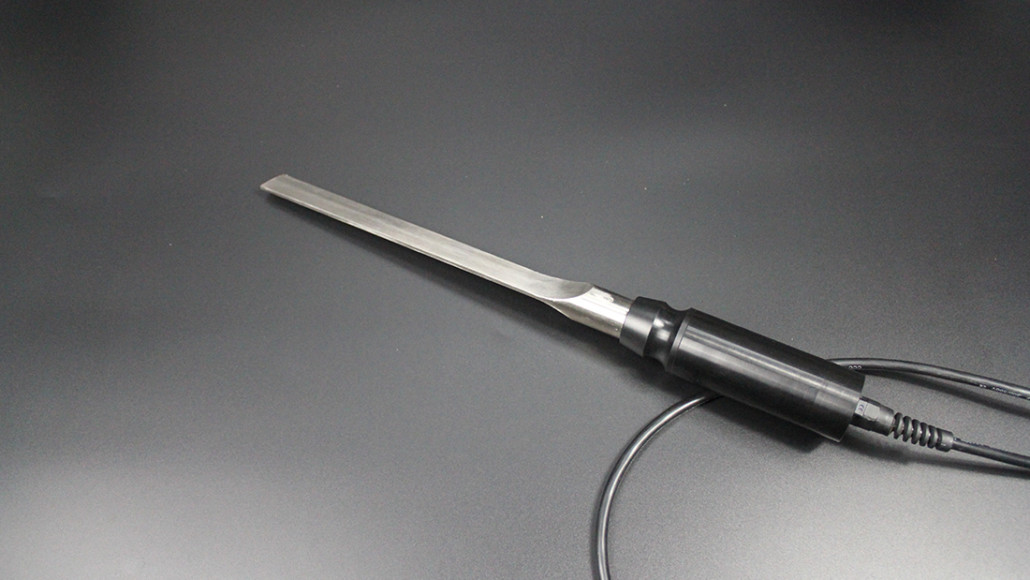
An ultrasonic knife is a cutting tool that uses high-frequency mechanical vibrations to reduce friction and the force required to slice through food . Unlike traditional knives that rely solely on a sharp edge and brute force to wedge through ingredients, an ultrasonic knife employs a piezoelectric transducer inside the handle. This device converts electrical energy into mechanical motion, causing the blade to vibrate at an astonishing rate more than 40,000 times per second .
The concept is not entirely new; ultrasonic cutting has been used in industrial and medical settings for decades. In factories, it’s used to cut everything from cakes and cheese to rubber and textiles with incredible precision and minimal waste . In the medical field, ultrasonic scalpels are used for delicate surgeries to cut tissue and cauterize wounds simultaneously . The challenge was to miniaturize this powerful technology into a handheld, battery-powered device that is safe, ergonomic, and practical for the home cook. The C-200 from Seattle Ultrasonics is the first of its kind to achieve this, bringing industrial-grade technology to residential kitchens .
The Science of “Good Vibrations” in the Kitchen
The magic of the ultrasonic knife lies in its imperceptible vibrations. While you can’t see, hear, or feel them, these microscopic vibrations are the key to its superior performance . When the blade vibrates at such a high frequency, it creates a “non-stick” effect by minimizing the contact area and friction between the blade’s surface and the food . This is achieved through a phenomenon where the rapid oscillations prevent food particles from bonding to the steel, allowing the blade to glide through with significantly less resistance.
The primary benefit of this reduced friction is a dramatic decrease in the amount of force required to make a cut. The developers of the C-200 claim it reduces the necessary cutting force by up to 50% . For the cook, this translates to less physical effort, reducing fatigue during long meal-prep sessions. The cutting action becomes more of a gentle glide than a forceful chop. This technology “makes the knife behave sharper than it physically is,” demonstrating that the cutting action is not just about the sharpness of the edge, but the energy imparted by the vibrations .
Furthermore, the “non-stick” effect has another significant advantage: cleaner cuts and easier cleanup. Food is less likely to stick to the blade, meaning your slices of potato, onion, or tomato will fall away cleanly, and the blade itself will require less effort to clean . This is a stark contrast to traditional knives where starchy or sticky foods can cling to the blade, making the process messy and inefficient.
First-Hand Testing and Performance
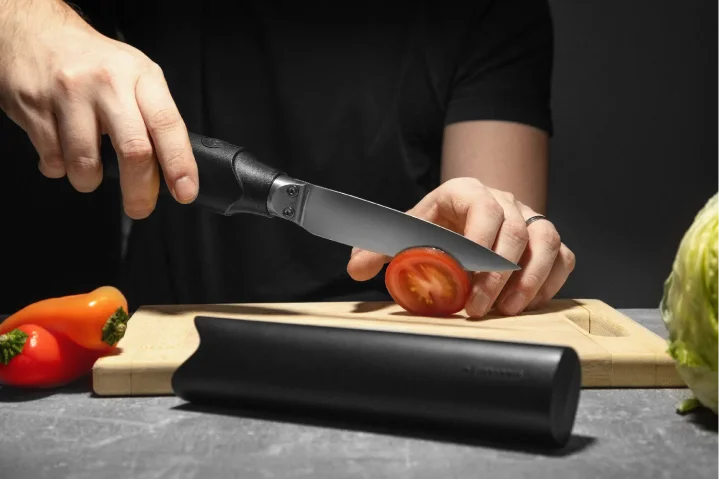
While the science sounds impressive, the real test is in the kitchen. Hands-on testing by culinary experts has confirmed that the knife’s performance lives up to its claims. In one such test, an editor found that slicing a potato was effortless. The slices separated cleanly and, due to the non-stick effect, fell away from the blade without sticking . Similar results were reported when cutting other notoriously tricky ingredients like bell peppers and tomatoes. The knife required minimal pressure to penetrate the skin of a tomato without crushing the delicate flesh inside, a task that often requires a razor-sharp traditional knife and a delicate touch .
A central part of the development was a rigorous testing phase to validate the knife’s performance. The creator used a robotic arm named “J Robot Choppenheimer” to conduct thousands of standardized cuts, comparing the ultrasonic knife against 21 of the most popular traditional chef’s knives on the market . By collecting data on cutting force, edge retention, and other metrics, the developer was able to scientifically prove that the ultrasonic technology reduced the effort required to cut food. This “Quantified Knife Project” moved the knife’s superiority from a subjective feeling to a data-backed fact .
Design, Build Quality, and Ergonomics
Despite its high-tech interior, the C-200 is designed to look and feel like a familiar, high-quality chef’s knife. It features an 8-inch blade, which is the standard “workhorse” size for most home cooks and professional chefs alike . The blade itself is made from Japanese AUS-10 san mai stainless steel, a material prized for its durability, corrosion resistance, and ability to hold a sharp edge . “San mai” refers to a three-layer construction, which provides a hard, central cutting core surrounded by softer, more flexible layers, giving the blade an excellent balance between durability and a keen edge. With a Rockwell Hardness rating of 60HRC and a 13-degree edge angle, it is designed for high performance even when the ultrasonic power is turned off .
The handle houses the battery and electronics and is designed to be ambidextrous and water-resistant, boasting an IP65 rating . This means it can be safely washed by hand without worrying about damage from water. The power button is conveniently placed so it can be depressed with the thumb while holding the knife naturally . The knife charges via a USB-C port or, for a more elegant solution, with an optional solid hardwood wireless charging tile that can be mounted to a wall .
Who Can Benefit from an Ultrasonic Knife?
While this knife will appeal to any culinary enthusiast, its unique benefits can be a game-changer for several specific groups.
A. Home Cooks with Limited Mobility or Strength: For individuals with arthritis, carpal tunnel syndrome, or other conditions that cause hand pain or weakness, the ability to cut with 50% less force can make food preparation accessible and enjoyable again. It significantly reduces the physical strain and discomfort associated with prolonged chopping and slicing .
B. Professional Chefs and Culinary Students: In a fast-paced professional kitchen, speed and precision are paramount. An ultrasonic knife can dramatically reduce prep time and the physical fatigue that comes from hours of repetitive cutting. The clean, precise cuts also improve the aesthetic quality of dishes, and the technology allows for creative, intricate cuts that are difficult to achieve with a traditional knife.
C. Ergonomic and Safety-Conscious Cooks: The reduced force required to cut means less chance of an accidental slip. Because the blade glides through food with less pressure, the risk of the knife suddenly breaking free from a tough ingredient and causing injury is lowered. Furthermore, the reduced effort leads to better control and less fatigue, which promotes a safer cutting environment.
D. Anyone Tired of Dull Knives: While this knife is equipped with a high-quality blade that can be sharpened traditionally, it relies on technology to “behave sharper than it is” . For those who dread the task of sharpening their knives or struggle to maintain a razor-sharp edge, this knife offers a consistently high-performance cut without requiring constant maintenance.
Beyond the Home Kitchen: Industrial and Medical Applications
The journey of ultrasonic cutting from the factory floor to the kitchen is a testament to its versatility. In the industrial sector, ultrasonic cutting is prized for its ability to cut a wide range of materials cleanly and efficiently without creating dust or frayed edges . It is used to cut composite materials, rubber, plastics, and especially food.
A. Food Industry: Ultrasonic cutters are used to slice delicate items like cakes, confectionery, and cheese where a traditional blade would deform or crush the product. The technology allows for high-speed, precise cuts with zero waste and no product residue sticking to the blade, which is crucial for high-volume food manufacturing .
B. Textiles and Automotive: The ability to cut and seal edges in a single step is invaluable for synthetic textiles and non-wovens. The ultrasonic energy melts the edges of the material during cutting, preventing fraying and eliminating the need for a separate sealing process . In the automotive industry, it’s used to cut tough materials like rubber and carpets .
C. Medical Field: In medicine, ultrasonic scalpels are used for precise, low-trauma cutting. In addition to cutting, the high-frequency vibrations can coagulate blood, reducing bleeding during surgery and providing a clearer operating field .
The Future of Ultrasonic Kitchen Technology
The C-200 ultrasonic chef’s knife is just the beginning. The success of this tool is paving the way for a whole new “sonification” of the kitchen. The creator has hinted at a long product roadmap that includes other ultrasonic tools, as patents have already been filed for an ultrasonic ice cream scoop that could use vibrations to break up ice crystals with less friction .
The concept is simple: if you can apply ultrasonic technology to a knife, why not to other cutting and preparation tools? Planned expansions to the lineup include an ultrasonic bread knife, a santoku, and a vegetable cleaver . The challenge for some tools, like a paring knife, lies in miniaturizing the technology to fit into a smaller handle. However, as the technology evolves, it’s likely we will see an entire suite of ultrasonic tools that make every aspect of food prep more effortless, efficient, and enjoyable. The ultrasonic knife has shown that the future of cooking is not just about new ingredients or recipes, but about reimagining the fundamental tools we use to create our meals.
Conclusion
The introduction of the ultrasonic kitchen knife marks a significant milestone in culinary technology. By harnessing high-frequency vibrations, this tool reduces the physical effort of cutting by half, delivers cleaner and more precise slices, and ensures that food doesn’t stick to the blade . While its $399 price point positions it as a premium investment, its benefits are tangible. For those with physical limitations that make traditional cooking challenging, or for culinary enthusiasts seeking the ultimate in performance and precision, it represents a genuine leap forward . As we look to the future, the ultrasonic knife is likely just the first of many tools that will “sonify” the kitchen, making food preparation faster, easier, and more enjoyable for everyone.